Waarom Instituties Altijd Verliezen van de Biologie
Beste lezer,
Dit laatste hoofdstuk biedt geen nuance, geen compromis en geen beleidsadvies. Het maakt af waar de voorafgaande hoofdstukken onvermijdelijk naartoe werkten.
De mens is een biologisch organisme dat verandert onder druk, leert via frictie en stabiliteit verkiest boven waarheid. Instituties zijn culturele constructies die verandering proberen te organiseren zonder risico, leren willen afdwingen zonder noodzaak en gedrag proberen te sturen zonder inzicht in de biologie waarop dat gedrag rust.
Die twee werelden zijn niet te verenigen.
In dit hoofdstuk wordt duidelijk waarom onderwijs, justitie en andere instituties niet toevallig falen, maar structureel moeten falen. Niet door slechte bedoelingen of incompetentie, maar omdat zij zijn gebouwd op aannames die evolutionair onjuist zijn. De mens is geen project, geen kleistof, geen spreadsheet. Hij is een organisme dat zich aanpast wanneer het moet — en alleen dan.
Dit hoofdstuk is geen cynisch slot, maar een realistisch eindpunt. Wie hier aankomt, hoeft het niet eens te zijn, maar kan niet meer doen alsof het probleem oplosbaar is met betere intenties, fijnere regels of slimmere termen.
Lees dit hoofdstuk niet om hoop te vinden.
Lees het om helder te zien.
Met droge precisie,
Peter Koopman
7. DE EVOLUTIONAIRE KNOCK-OUT
Waarom instituties noodzakelijk falen, waarom mensen dit verdragen, en waarom de biologie altijd wint
Na duizenden woorden dissectie is de ontluisterende conclusie eigenlijk bedroevend eenvoudig:
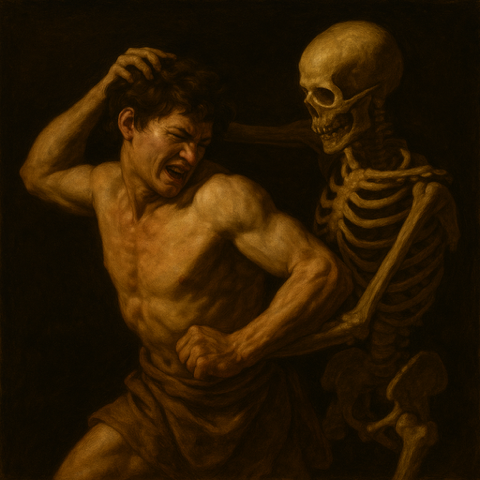
De mens en zijn instituties opereren volgens tegengestelde principes.
De mens is biologisch, de institutie bureaucratisch.
De mens leert door noodzaak, de institutie door rapportage.
De mens verandert door risico, de institutie door beleid.
Dat is geen fout. Het is geen mislukking.
Het is een onverzoenlijk conflict tussen evolutie en constructie.
De mens is een dier dat leeft volgens wetten die 2 miljoen jaar oud zijn.
Instituten zijn rituele machines die werken volgens ficties die 200 jaar oud zijn.
Ze zijn nooit ontworpen voor elkaar.
1. De mens leeft in feedback; instituten leven in symboliek
Evolutionaire systemen:
- registreren schade,
- reageren onmiddellijk,
- verleggen gedrag bij gevaar,
- sterven uit als ze falen.
Institutionele systemen:
- registreren vooral papier,
- reageren vertraagd,
- verleggen beleid bij kritiek,
- worden groter als ze falen.
Een roofdier dat niet kan jagen, sterft.
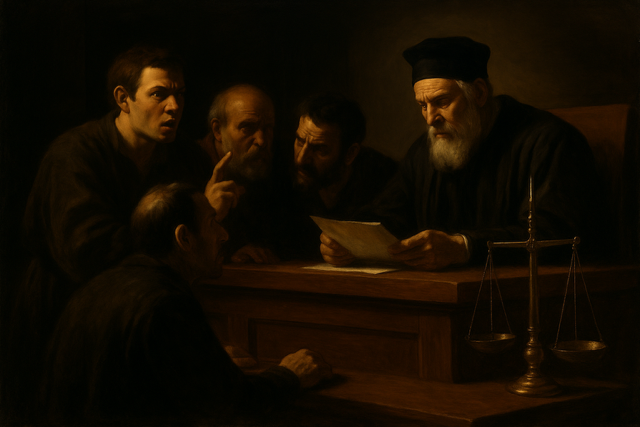
Een justitie- of onderwijssysteem dat niet functioneert, krijgt extra budget.
Dat is het verschil tussen natuur en narratief.
2. De mens leert door pijn; instituties vermijden pijn
De mens is gebouwd op:
- homeostase (behoud),
- plasticiteit (aanpassing onder druk),
- verliesaversie (pijn vermijden),
- statusbewaking (sociaal risico),
- en noodzaak (leren bij bedreiging).
Instituten minimaliseren:
- risico,
- crisis,
- consequenties,
- en verantwoordelijkheid.
Daarom zijn ze evolutionair steriel.
Een systeem dat niets voelt, leert niets.
Een systeem dat niets verliest, verandert niets.
Een systeem dat geen risico draagt, wordt arrogant.
Het is Taleb’s wereld in een notendop.
3. De mens verandert langzaam, organisch en autonoom
Burke had gelijk in één cruciale zin:
Verandering die niet van binnenuit komt, wordt instinctief afgewezen.
De biologie werkt als volgt:
- interne verandering = acceptabel,
- externe verandering = bedreiging,
- snelle verandering = gevaar,
- abrupte verandering = mogelijk dodelijk.
Daarom falen:
- hervormingen,
- revoluties,
- curriculumveranderingen,
- justitiehervormingen,
- zorgstelsels,
- politieke reorganisaties.
Niet omdat de mens irrationeel is, maar omdat zijn brein juist razend rationeel is vanuit evolutionair perspectief.
Gewenst effect: orde.
Werkelijk effect: chaos.
Inmiddels een vaste traditie van beleid.
4. Illich: instituties produceren afhankelijkheid, geen autonomie
Illich ontmaskerde instituties als anti-versies van hun eigen idealen:
- school → ontleert vrijheid, creëert afhankelijkheid;
- zorg → ontneemt zelfredzaamheid, creëert patiëntidentiteit;
- justitie → produceert ritueel, geen recht;
- politiek → produceert theater, geen leiding.
Waarom?
Omdat instituties niets anders kunnen dan zichzelf reproduceren.
Een instituut kan nooit toegeven dat het faalt,
want dan vervalt zijn bestaansrecht.
En dus rationaliseren ze:
- waarom mislukking succes is,
- waarom groei nodig is,
- waarom kritiek misplaatst is.
Dit is de institutionele homeostase — net zo krachtig en rigide als de biologische.
5. De mens duldt dit omdat stabiliteit belangrijker is dan waarheid
De mens kan leven met:
- inefficiëntie,
- hypocrisie,
- rituelen,
- bureaucratie.
Maar hij kan niet leven met:
- willekeur,
- chaos,
- onzekerheid,
- risicovol bestaan.
De institutionele illusie is geen fout;
het is een evolutionair compromis.
Beter een systeem dat slecht werkt, maar voorspelbaar is,
dan een leven dat nauw aansluit op biologische realiteit,
maar sociaal onvoorspelbaar wordt.
Instabiliteit kost meer energie dan domheid.
En energiebesparing is de eerste wet van de evolutie.
6. De echte tragedie: instituties proberen iets te doen wat biologisch onverenigbaar is
Onderwijs probeert gedrag te veranderen zonder noodzaak.
Justitie probeert gedrag te remmen zonder risico.
Zorg probeert gezondheid te produceren zonder zelfredzaamheid.
Politiek probeert orde te creëren via symboliek.
Allemaal botsen ze met de biologische realiteit van het organisme.
Daarom falen ze.
Daarom zullen ze blijven falen.
En daarom moeten we ze begrijpen als rituelen, niet als gereedschappen.
Ze zijn culturele placebo’s — nuttig voor stabiliteit,
dodelijk voor effectiviteit.
7. De mens overleeft niet dankzij instituties, maar ondanks ze
De mens is een succesverhaal van adaptatie, improvisatie, opportunisme, drift en feedback.
Instituten zijn successen van elegantie, symboliek en legitimiteit — maar zelden van werking.
De mens blijft overeind dankzij evolutionaire robuustheid.
Instituten blijven overeind dankzij politiek ritueel.
Het feit dat de soort het volhoudt, is geen bewijs dat systemen werken,
maar dat organismen taai genoeg zijn om institutionele incompetentie te verdragen.
Dat is de cynische, maar verhelderende waarheid.
Instituten falen niet omdat ze slecht zijn, maar omdat ze proberen organismen te veranderen die biologisch gebouwd zijn om juist niet te veranderen zonder noodzaak.
De biologie wint. Altijd.
Literatuurlijst
Ainsworth, M. D. S. (1989). Attachments beyond infancy. American Psychologist, 44(4), 709–716.
Alexander, F. (1950). Psychoanalysis and Crime. New York, NY: Farrar & Rinehart.
Arendt, H. (1958). The Human Condition. Chicago, IL: University of Chicago Press.
Baumeister, R. F., & Tierney, J. (2011). Willpower: Rediscovering the Greatest Human Strength. New York, NY: Penguin Press.
Becker, E. (1973). The Denial of Death. New York, NY: Free Press.
Bloom, P. (2016). Against Empathy: The Case for Rational Compassion. New York, NY: Ecco.
Bowlby, J. (1982). Attachment and Loss: Vol. 1. Attachment (2nd ed.). New York, NY: Basic Books.
Buss, D. M. (2015). Evolutionary Psychology: The New Science of the Mind (5th ed.). New York, NY: Psychology Press.
Carlsmith, K. M., Darley, J. M., & Robinson, P. H. (2002). Why do we punish? Deterrence and just deserts as motives for punishment. Journal of Personality and Social Psychology, 83(2), 284–299.
Cialdini, R. B. (2009). Influence: Science and Practice (5th ed.). Boston, MA: Pearson.
Clark, A. (2016). Surfing Uncertainty: Prediction, Action, and the Embodied Mind. Oxford: Oxford University Press.
Crews, F. (2017). Freud: The Making of an Illusion. New York, NY: Metropolitan Books.
Damasio, A. R. (1994). Descartes’ Error: Emotion, Reason, and the Human Brain. New York, NY: Putnam.
Darwin, C. (1877). The Descent of Man and Selection in Relation to Sex. London: John Murray.
Dawkins, R. (1976). The Selfish Gene. Oxford: Oxford University Press.
Douglas, T., & Devolder, K. (2013). Moral enhancement and legal responsibility: The potential of direct interventions. Criminal Law and Philosophy, 7, 267–282.
Eisenberg, N. (2000). Emotion, regulation, and moral development. Annual Review of Psychology, 51, 665–697.
Feldman Barrett, L. (2017). How Emotions Are Made: The Secret Life of the Brain. New York, NY: Houghton Mifflin Harcourt.
Foucault, M. (1977). Discipline and Punish: The Birth of the Prison. New York, NY: Vintage Books.
Gazzaniga, M. S. (2011). Who’s in Charge? Free Will and the Science of the Brain. New York, NY: HarperCollins.
Girard, R. (1977). Violence and the Sacred. Baltimore, MD: Johns Hopkins University Press.
Gottfredson, M. R., & Hirschi, T. (1990). A General Theory of Crime. Stanford, CA: Stanford University Press.
Haidt, J. (2012). The Righteous Mind: Why Good People Are Divided by Politics and Religion. New York, NY: Pantheon Books.
Harris, G. T., Rice, M. E., & Quinsey, V. L. (1998). Actuarial assessment of risk among sex offenders. Psychological Assessment, 10(2), 221–237.
Hoffman, D. D. (2019). The Case Against Reality: Why Evolution Hid the Truth from Our Eyes. New York, NY: W. W. Norton.
Illich, I. (1971). Deschooling Society. New York, NY: Harper & Row.
Illich, I. (1976). Medical Nemesis: The Expropriation of Health. New York, NY: Pantheon.
Kahneman, D. (2011). Thinking, Fast and Slow. New York, NY: Farrar, Straus and Giroux.
Kandel, E. R. (2016). Reductionism in Art and Brain Science: Bridging the Two Cultures. New York, NY: Columbia University Press.
Laws, D. R., & O’Donohue, W. T. (2008). Sexual Deviance: Theory, Assessment, and Treatment (2nd ed.). New York, NY: Guilford Press.
Lieberman, D. (2013). The Story of the Human Body: Evolution, Health, and Disease. New York, NY: Pantheon Books.
Metzinger, T. (2009). The Ego Tunnel: The Science of the Mind and the Myth of the Self. New York, NY: Basic Books.
Miller, G. (2009). Spent: Sex, Evolution, and Consumer Behavior. New York, NY: Viking.
Pinker, S. (2011). The Better Angels of Our Nature. New York, NY: Viking.
Prentky, R. A., & Barbaree, H. E. (1997). Classification of Sexual Disorders. Thousand Oaks, CA: Sage.
Quinsey, V. L., Harris, G. T., Rice, M. E., & Cormier, C. A. (2006). Violent Offenders: Appraising and Managing Risk(2nd ed.). Washington, DC: APA Press.
Sapolsky, R. M. (2017). Behave: The Biology of Humans at Our Best and Worst. New York, NY: Penguin Press.
Schönfeld, B., & Stevenson, J. (2001). Paraphilia and sexual offending. Journal of Sexual Aggression, 7(3), 13–23.
Taleb, N. N. (2012). Antifragile: Things That Gain from Disorder. New York, NY: Random House.
Taleb, N. N. (2010). The Black Swan: The Impact of the Highly Improbable (2nd ed.). New York, NY: Random House.
Tomasello, M. (2014). A Natural History of Human Thinking. Cambridge, MA: Harvard University Press.
Wilson, E. O. (1975). Sociobiology: The New Synthesis. Cambridge, MA: Harvard University Press.
Wright, R. (1994). The Moral Animal: Why We Are the Way We Are. New York, NY: Vintage.
Zimbardo, P. G. (2007). The Lucifer Effect: Understanding How Good People Turn Evil. New York, NY: Random House.